





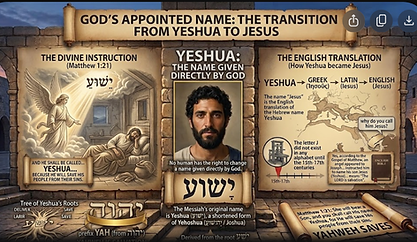
The Messiah’s original name is Yeshua and Gods name is Yehovah
The historical and manuscript record, along with scriptural warnings, details several critical points regarding the alteration and replacement of God’s personal name:
Commandment number three
1. Scriptural Warnings Against Altering Divine Words and sacret Names
Scripture explicitly forbids human tradition from modifying, adding to, or subtracting from the divine pattern:
Deuteronomy 4:2 & 12:32: "You shall not add to the word which I command you, neither shall you diminish ought from it, that you may keep the commandments of the Lord your God which I command you."
Proverbs 30:4–6: "What is His name, and what is His Son’s name, if thou canst tell? Add thou not unto His words, lest He reprove thee, and thou be found a liar." YEHOVAH & Yeshua
Exodus 3:15: When revealing His memorial name יהוה (YHWH), God commanded: "This is My name forever, and this is My memorial unto all generations." Yehovah
Jeremiah 23:26–27: The Father directly confronts spiritual leaders who cause His people to lose His name through human practices: "Which think to cause My people to forget My name by their dreams... as their fathers have forgotten My name for Baal [literally, 'The Lord']."\
Revelation 22:18–19: Warns of severe divine judgment on anyone who adds to or removes words from the biblical text.
2. The Systematic Replacement: The "6,800+ Times"
In the Hebrew Tanakh (Old Testament), the personal name of the Father—the Tetragrammaton (יהוה / YHWH) appears 6,828 times. Yehovah
The Scribes' Oral Prohibition: Starting in the Second Temple era, an excessive fence was built around the Third Commandment ("Thou shalt not take the name of the Lord thy God in vain"). Scribes and rabbis declared it unlawful or sacrilegious to speak the four-letter name aloud, replacing it orally with Adonai ("Lord") or Elohim ("God"). His name is Yehovah
Masoretic Vowel Pointing: In medieval copies of the Hebrew text, Jewish Masoretes inserted the vowel points of Adonai onto the consonants of YHWH as an explicit reminder to the reader to vocalize "Adonai" rather than pronounce the sacred name. Yehovah
The "LORD" Substitution in English Bibles: Christian Bible translations (from William Tyndale and the Geneva Bible to the 1611 King James Version and modern translations) adopted this tradition. Instead of transliterating the Creator's personal name, they systematically substituted the uppercase title "the LORD" nearly 7,000 times. for Yehovah
3. The 134 Sopheric Alterations (Tiqqune Sopherim)
Ancient Jewish records document that the Sopherim (early scribes) deliberately altered the written consonantal text in specific passages:
Massorah Antiqua Records: In 134 separate Old Testament passages, scribes intentionally changed the written name יהוה (YHWH) to the title Adonai in the manuscript text itself.
The Rationale: The scribes believed the anthropomorphic language or direct statements about YHWH in those specific passages were too familiar or showed lack of reverence, so they altered the inspired consonants in the scrolls. (Documented in standard Hebrew scholarly references, including Ginsburg's The Massorah and the Bullinger Companion Bible Appendix 32).
4. The Vatican Injunction Against Pronouncing the Divine Name
The institutional suppression of God's personal name is not merely ancient history; it has been enforced in modern church governance: His name is Yehovah
The 2008 Vatican Directive on the Name of God: On June 29, 2008, Cardinal Francis Arinze of the Congregation for Divine Worship and the Discipline of the Sacraments issued a formal letter to Catholic Bishops’ Conferences worldwide.
The Mandate: The Vatican decreed that in liturgical celebrations, hymns, and prayers, the proper name of God—specifically "Yahweh" or the Tetragrammaton YHWH—is never to be used or pronounced. Instead, it must always be replaced by translations equivalent to "the Lord" (such as Dominus, Signore, Señor, Herr).
The Justification: The directive cited ancient tradition and liturgical continuity as superior to vocalizing the Hebrew covenant name.
5. The Greek and Latin Shift to "Jesus"
The Messiah’s Hebrew name was Yeshua (יֵשׁוּעַ), meaning "YHWH is salvation" (Matthew 1:21):
Absence of the "J": Ancient Hebrew, Aramaic, Greek, and Latin contained neither the letter "J" nor its hard sound.
The Path to Translation:
In the Greek New Testament, Yeshua was transliterated into Iēsous (Ἰησοῦς) because Greek lacks the "sh" sound and requires masculine nouns to end in "s".
In Latin, this became Iesus.
Only after the 16th–17th centuries, when the letter "J" was distinguished from "I" in European vernacular languages, did the English rendering become Jesus.
Impact of the Change: Removing the theophoric root Yah severed the obvious linguistic connection between the Father (YHWH) and the Son's purpose (Yeshua / "YHWH saves"), transforming a direct theological truth into a Westernized transliteration[cite: 2].
1. The Eternal Perpetuity of the Name
Scripture emphasizes that the Father's personal name was not temporary, nor was it subject to retirement or replacement across generations:
Exodus 3:15: "And God said moreover unto Moses, Thus shalt thou say unto the children of Israel, The LORD God of your fathers, the God of Abraham, the God of Isaac, and the God of Jacob, hath sent me unto you: this is my name for ever, and this is my memorial unto all generations."
Psalm 102:12: "But thou, O LORD, shalt endure for ever; and thy remembrance unto all generations."
Psalm 135:13: "Thy name, O LORD, endureth for ever; and thy memorial, O LORD, throughout all generations."
2. Divine Jealousy and Protection of the Name
The Creator explicitly states that He guards His personal name from being profaned, polluted, or obscured by human traditions and heathen practices:
Exodus 34:14: "For thou shalt worship no other god: for the LORD, whose name is Jealous, is a jealous God."
Ezekiel 36:21–23: "But I had pity for mine holy name, which the house of Israel had profaned among the heathen, whither they went. Therefore say unto the house of Israel, Thus saith the Lord GOD; I do not this for your sakes, O house of Israel, but for mine holy name's sake... And I will sanctify my great name, which was profaned among the heathen... and the heathen shall know that I am the LORD."
Ezekiel 39:7: "So will I make my holy name known in the midst of my people Israel; and I will not let them pollute my holy name any more: and the heathen shall know that I am the LORD, the Holy One in Israel."
Leviticus 22:32: "Neither shall ye profane my holy name; but I will be hallowed among the children of Israel: I am the LORD which hallow you."
3. The Prophetic Rebuke for Substituting the Name
The prophets openly condemned spiritual leaders who replaced the divine name with generic terms or allowed the covenant name to fall out of use:
Jeremiah 23:26–27: "How long shall this be in the heart of the prophets that prophesy lies? yea, they are prophets of the deceit of their own heart; which think to cause my people to forget my name by their dreams which they tell every man to his neighbour, as their fathers have forgotten my name for Baal [Hebrew: 'The Lord/Master']."
Malachi 1:6: "A son honoureth his father, and a servant his master: if then I be a father, where is mine honour? and if I be a master, where is my fear? saith the LORD of hosts unto you, O priests, that despise my name. And ye say, Wherein have we despised thy name?"
Malachi 2:1–2: "And now, O ye priests, this commandment is for you. If ye will not hear, and if ye will not lay it to heart, to give glory unto my name, saith the LORD of hosts, I will even send a curse upon you..."
4. Prophecies of Restoration: The Name Revealed Anew
The Scriptures foretell a time when human substitutions will end, and the redeemed will know and proclaim the authentic name:
Isaiah 52:6: "Therefore my people shall know my name: therefore they shall know in that day that I am he that doth speak: behold, it is I."
Zechariah 14:9: "And the LORD shall be king over all the earth: in that day shall there be one LORD, and his name one."
Zephaniah 3:9: "For then will I turn to the people a pure language, that they may all call upon the name of the LORD, to serve him with one consent."
Hosea 2:16–17: "And it shall be at that day, saith the LORD, that thou shalt call me Ishi [my husband]; and shalt call me no more Baali [my master/lord]. For I will take away the names of Baalim out of her mouth, and they shall no more be remembered by their name."
5. Salvation Tied Specifically to the Name
Scripture does not base deliverance on arbitrary or generic titles, but ties covenant authority directly to the true name:
Joel 2:32 (quoted in Acts 2:21 and Romans 10:13): "And it shall come to pass, that whosoever shall call on the name of the LORD shall be delivered."
Acts 4:12: "Neither is there salvation in any other: for there is none other name under heaven given among men, whereby we must be saved."
John 17:6, 26: Yeshua proclaimed to the Father: "I have manifested thy name unto the men which thou gavest me out of the world... And I have declared unto them thy name, and will declare it."
Philippians 2:9–10: "Wherefore God also hath highly exalted him, and given him a name which is above every name: that at the name of Yeshua every knee should bow, of things in heaven, and things in earth, and things under the earth."
Who has ascended into heaven and descended?
Who has gathered the wind in His fists?
Who has wrapped the waters in His garment?
Who has established all the ends of the earth?
What is His name or His Son's name? 6. Surely you know. Proverbs 30:4
Yehovah (יְהֹוָה) represents the written form of God’s sacred, four-letter covenant name—known as the Tetragrammaton (YHWH / יהוה)—as preserved in the Masoretic Hebrew text of the Old Testament.
1. The Hebrew Text: The Four Letters (יהוה)In the Hebrew Scriptures, this personal name appears nearly 7,000 times. It consists of four Hebrew consonants, read from right to left:י (Yod)ה (He)ו (Vav / Waw)ה (He)
This is the name God revealed to Moses at the burning bush when He declared:"And God said unto Moses, I AM THAT I AM: and he said, Thus shalt thou say unto the children of Israel, I AM hath sent me unto you... this is my name for ever, and this is my memorial unto all generations." Exodus 3:14–15 Linguistically, the name is built upon the Hebrew root verb הָיָה (hayah), meaning "to be" or "to exist." It conveys the eternal, self-existent nature of the Creator: the One who was, who is, and who continually is to come.2. How the Vowels "Yehovah" (יְהֹוָה)
Yehovah as the Authentic, Preserved Pronunciation
In recent decades, a growing number of Hebrew manuscript scholars, Karaite researchers (such as Nehemia Gordon), and Messianic believers have challenged the Adonai substitution theory. They argue that Yehovah is the true, original pronunciation:
No human has the right to change a name given directly by God. why do you call him Jesus? According to the Bible, an angel instructed Joseph to name his son Yeshua. Matthew 5:18 Yes, according to the Gospel of Matthew, an angel appeared to Joseph in a dream and instructed him to name his son Jesus (Yeshua) because he would save his people from their sins. The name "Jesus" is the English translation of the Hebrew name Yeshua, which means "Yahweh saves" or "The LORD is salvation"
Factual Note:
The Messiah’s original name was Yeshua (יֵשׁוּעַ), a shortened form of Yehoshua (יְהוֹשׁוּעַ / Joshua). Hebrew etymology: It derives from the root יָשַׁע (yasha — to save, deliver, rescue). The name combines the theophoric prefix Yah (from יהוה / Yahweh) + shua (salvation/cry for help), literally meaning "Yahweh saves" or "Yahweh is salvation."
Hebrew Alphabet History:
The Hebrew alphabet consists of 22 letters and has never included the letter "J" or the "J" sound. Ancient Hebrew used the yod (י) which produces a "Y" sound (as in "yes"). The Savior’s name in Hebrew letters is ישוע (Yod-Shin-Vav-Ayin), pronounced approximately Yeh-shoo-ah or Yah-shoo-ah. The letter J did not exist in any alphabet until the 15th-17th centuries in European languages
By changing the names, they "subtracted" the power of the Hebrew identity and "added" a Western identity.
Ya'akov (the name of the Patriarch) was turned into James—a name that didn't even exist in the ancient world.
Yeshua (The Father's Salvation) was turned into a generic, 600-year-old English label.
The Verdict: If you are following "Jesus and James," you are following a Westernized translation. If you want to walk the Narrow Way, you must return to the Original Blueprint: Yeshua and His disciples who lived and died by the Torah.